

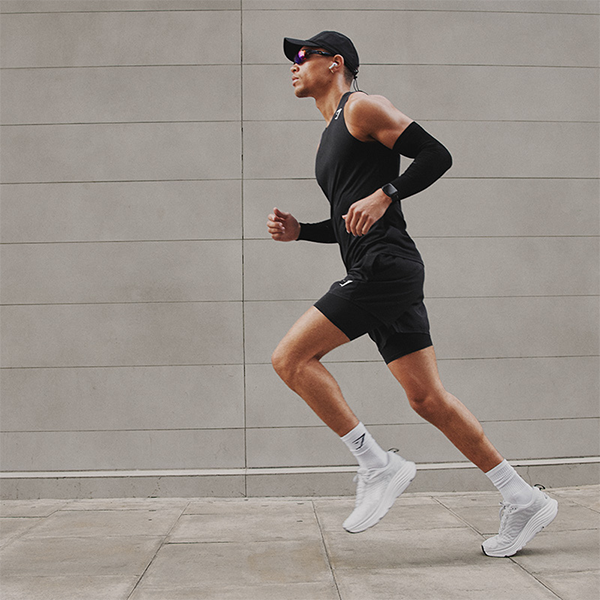
You spend serious time optimizing what goes into your body before and after training. But for 60 minutes in the middle of your session, you’re wearing a synthetic shirt that’s releasing chemical residues into your skin at a rate higher than any other moment in your day.
The exercise state is not just a window for performance. It’s also the highest dermal absorption window in your daily routine.
Why Exercise Amplifies What You Absorb From Clothing
The skin is your body’s largest organ and one of its primary interfaces with the external chemical environment. Its permeability — how readily it allows compounds to cross from exterior contact to systemic circulation — is not fixed. It varies significantly based on physiological state.
Exercise changes dermal absorption in three documented ways.
Temperature increases skin permeability. Core temperature rises during exercise, increasing blood flow to the skin surface. Warmer skin is more permeable skin. This is the same biological mechanism that makes warm-weather chemical exposure more relevant than cool-weather exposure.
Sweat acts as a carrier solvent. Sweat is a polar solvent that dissolves water-soluble compounds from the fabric surface and delivers them directly to the skin with the moisture of the sweat itself. Compounds that sit on fabric surfaces in dry conditions become mobile in the presence of sweat, actively moving toward skin contact.
Pores dilate during thermoregulation. The body’s attempt to cool itself through sweating involves dilation of the structures through which sweat reaches the surface. This dilation creates a larger pathway for compound absorption in both directions — sweat out, chemical residues in.
The net effect: an hour of exercise in a synthetic shirt delivers more fabric chemical exposure than 12 hours of casual wear in the same shirt. This is not a marginal difference. Research on dermal absorption in different physiological states shows order-of-magnitude differences between exercise-state and rest-state absorption for some compounds.
The biohacker who optimizes every input during training is ignoring the one with the highest absorption rate during the session itself.
What This Means for Your Training Shirt Specifically
The chemicals most concerning in workout clothing — formaldehyde finishing compounds, azo dye residues, synthetic antimicrobials — are precisely the compounds that become most mobile under exercise conditions. They’re water-adjacent in their chemistry. Sweat carries them.
For health-conscious men who’ve built a precise protocol around what they put into their bodies, this is the obvious gap: organic cotton t shirts mens with GOTS certification eliminate the exercise-state absorption entirely because the prohibited compounds aren’t in the fabric.
Not managed. Eliminated.
What to Look for in Training Shirts for Maximum Absorption Reduction
Zero Chemical Residues at the Source
The complete solution to sweat-activated chemical absorption is wearing a shirt that contains nothing harmful to absorb. GOTS certification prohibits the specific compounds that dermal absorption research identifies as concerns during exercise. The prohibition is supply-chain-wide — from farming inputs through dye chemistry to finishing treatments.
Natural Fiber Architecture
Organic cotton fiber doesn’t require surface coatings to manage moisture. Its natural fiber architecture moves sweat through the fabric without chemical treatment intermediaries. The absence of chemical coatings means there are no coating residues to become mobile under exercise conditions.
Heat and Sweat Testing
The marketing test for most activewear is how it performs in controlled conditions. The relevant test for dermal absorption risk is how it performs under sustained exercise at elevated temperature with significant sweat production. GOTS-certified organic cotton performs this test without generating the chemical exposure event that synthetic workout shirts do.
Certification Rather Than Claims
Self-described “chemical-free” training shirts without third-party certification are making a claim they can’t verify. The manufacturing chain for any garment involves chemical inputs at multiple stages. GOTS is the standard that independently verifies that specific harmful compounds were excluded from each stage.
Building the Biohacking Case
Men who biohack their training typically track inputs with unusual precision. Pre-workout timing, carbohydrate type, caffeine dose, sleep timing. Every variable that affects training performance and hormonal response is mapped and optimized.
The training shirt variable isn’t on the map for most men. It should be.
The mechanism is documented. Dermal absorption during exercise is not speculative. It’s studied and quantified in occupational health, pharmaceutical research (transdermal drug delivery), and environmental exposure research.
The exposure duration is significant. A serious training program involves 60-90 minutes of peak-absorption conditions four to six times per week. Over a year of training, that’s hundreds of hours of elevated-absorption synthetic fabric contact.
The fix is a gear decision, not a protocol change. Switching to organic cotton t shirts mens requires no behavior change. You still train the same way, at the same time, with the same intensity. The shirt is the only variable that changes.
Why This Hasn’t Been on the Biohacking Radar
The biohacking community has systematically applied scientific rigor to inputs that the fitness industry already discusses: nutrition, sleep, supplementation, cold therapy. Fabric chemistry doesn’t appear in most biohacking frameworks because it doesn’t appear in mainstream fitness content.
The gap isn’t evidence that it doesn’t matter. It’s evidence that the biohacking community hasn’t connected the dermal absorption research to the training context yet.
This article is that connection. The mechanism is established. The exposure is real during every training session in synthetic clothing. The gear decision is simple.
Update your protocol. Your training shirt is a variable worth optimizing.